
In early 2025, I was playing.
That is the honest word for it. Playing. Discovering. Amazed.
ChatGPT, Claude, DeepSeek – one after another, I was learning what they could do. I am an autodidact by nature. I learn by touching things, by trying, by making mistakes in private before I speak in public. And what I was touching felt extraordinary: the speed…..the fluency…the confidence of the outputs.
I stopped checking them, somehow not consciously. I just… stopped. Because they felt so right, no contra-argument.
Then my daughter needed help with a school project.
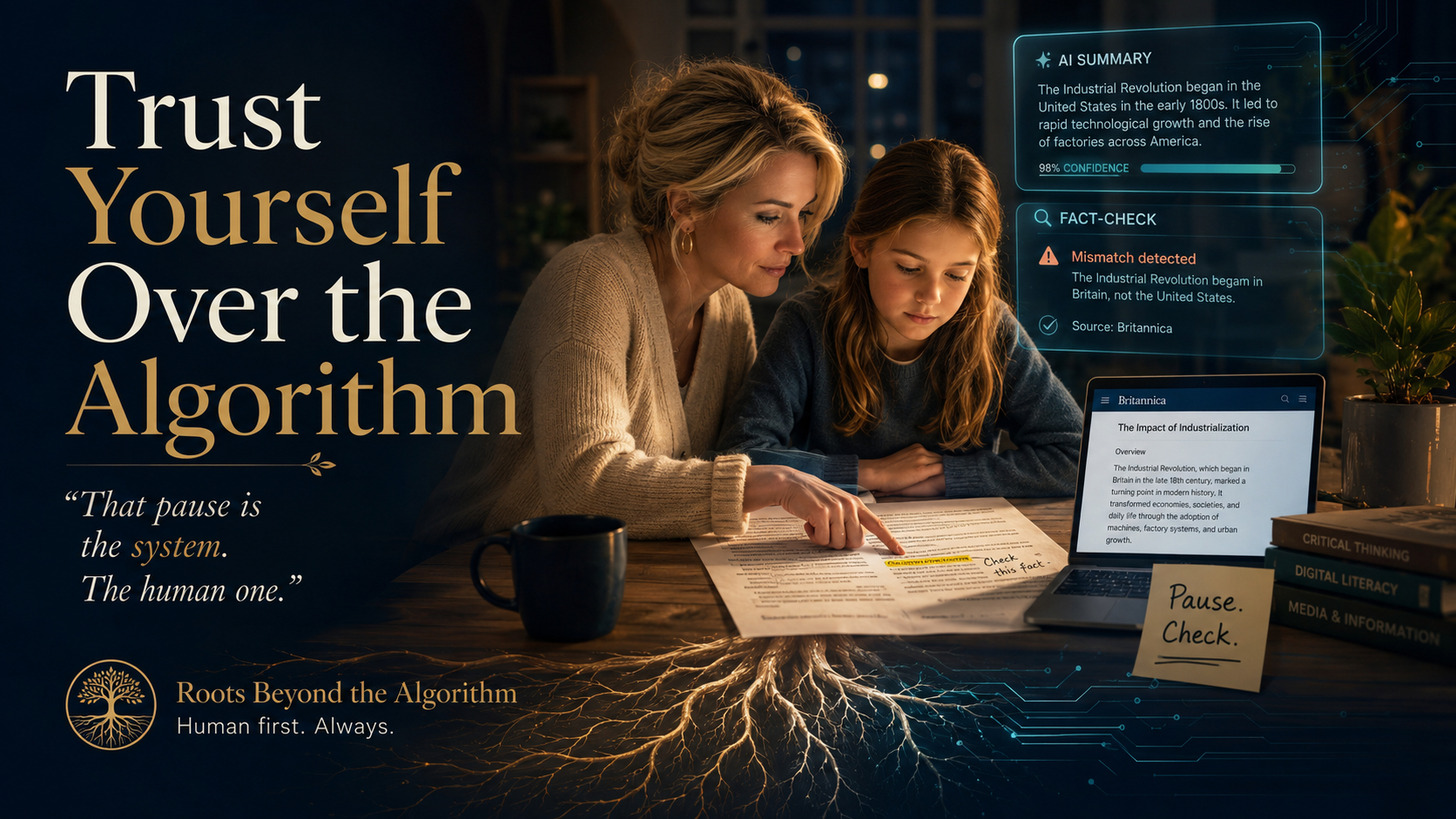
We searched together, gathered information, shaped it into something coherent. We were in a hurry, the way families always are, life pressing from every direction. The work looked good, it read well and we were about to print.
And something in me said: wait.
“Read it out loud,” I told her. “Let’s hear it before it goes on paper.”
She read. And there it was: facts that were wrong. Confident, fluent, well-structured and of all wrong.
We stopped. We checked against official sources and made corrections.
And something shifted in me that evening. Not panic or disillusionment. Something quieter and more important than both.
A door opened.
I work in data privacy. I think professionally about risk, about systems, about what happens when something fails and no one was watching. I know the frameworks. I know the language of accountability.
And I had still, in my own home, with my daughter, almost printed something false because the output felt authoritative.
That is the moment I understood something I now say out loud, in every professional conversation I have:
Systems are well trained. But that is exactly what they are: systems.
They learn. They test. They develop. They produce outputs that look, sound, and feel like knowledge.
The difference is not capability but responsibility.
A human owns what they do with information. A system does not. It cannot. Responsibility requires consciousness. It requires the ability to say I was wrong and mean it. It requires a daughter reading out loud before hitting print.
This personal moment sent me searching. And I quickly discovered I was not alone…not even close. The phenomenon even has a name: hallucination. In AI, this is what we call it when a system generates information that sounds completely credible, but is factually wrong, invented, or simply does not exist. With no warning, or disclaimer….just confidence. The web is full of examples across every field. I found a strange kind of comfort in that. A U.S. attorney submitted six case citations to a federal court (Mata v Avianca), all generated by ChatGPT, none of them real. The difference between us? I caught it before printing. He didn’t.
This is why, for every system we build, every algorithm we deploy, every AI we integrate into our workflows, there must be a human who monitors. Who checks. Who says wait.
Not because the technology is bad, but because responsibility cannot be automated.
We understand already that technology travels faster than our brain can process it.
So the question I carry now, the one I think our industry is not asking loudly enough, is this:
Where do we slow down enough to actually understand what is changing?
Not just technically, nor just legally.
But in us. In how we think, in what we trust and in what we teach our kids.
I almost printed a lie.
I caught it because I paused.
That pause is not a weakness in the system.
That pause is the system. The human one. The only one that matters.
I leave you with an open question (and answer please honestly to your own selves):When was the last time you paused, you questioned and checked?
#HumanFirst #AIGovernance #DataPrivacy #AIHallucination #ResponsibleAI #HumanInTheLoop #AILiteracy #CriticalThinking #DigitalEthics #RootsBeyondTheAlgorithm

Leave a Reply